
Our job is to solve problems between wildlife and humans; anything where wildlife interacts with humans and becomes a problem. It could be a raccoon living in the chimney, birds in the attic, squirrels, snakes.
- Wayne Witkowski (Worcester Telegram July 24, 2006)
Worcester Telegram & Gazette - July 24, 2006
Column: ON THE JOB
What do you do?
"Our job is to solve problems between wildlife and humans, anything where wildlife interacts with humans and becomes a problem. It could be a raccoon living in the chimney, birds in the attic, squirrels, snakes."
How did you get into this field?
"I was a fur trapper, and I had the knowledge and equipment. I started off doing extra jobs for friends, and it ended up being a separate business, a lucrative business."
Is there a lot of interaction between humans and wildlife in the city, compared with the suburbs and rural areas?
"Urban wildlife has evolved to live closer to humans, and to feed off us. Where the human population is dense, the animal population will be dense. The big difference is that there are more animals in a tighter-knit area. In the suburbs, if I'm dealing with squirrels in a house, I'm probably dealing with five to 10 squirrels. In the city, it's probably going to be 15 to 20 squirrels. They learn to overlap their territory, just like humans learn to live closer together in the city. Birds tend to poke into the houses in the city, and in the country they're more likely to stay in the woods. ... Deer are destroying the gardens on Flagg Street (in Worcester). Nobody hunts them there."
What's the most unusual animal you've been called to remove?
"We do a lot of domestic pet rescues. One of the most oddball ones we've done is the rescue of a 10-foot ball python that escaped. We do carcass removal. We're one of a few that will remove animals that are deceased in large numbers. People that collect cats, that kind of deal. We've done 34 cats out of a house, 20 dogs out of a house. We get some odd ones, porcupines out of a house. If we did one porcupine every three or four years, it was a big thing. Now, we're doing them yearly. The farmers call because they're in the sweet corn, or in the apple orchard, destroying it. Strawberry farmers call us for raccoons."
Is your business regulated by the state?
"I believe we're one of most highly regulated companies because of the trapping laws. We hold multiple permits for moving animals, euthanizing animals. If it's endangered wildlife, we have to go through another kind of permit. The state Department of Fisheries and Wildlife and the Massachusetts Humane Society are constantly monitoring us."
Do you make sure that the animals are handled humanely and not unnecessarily euthanized?
"Yes. That's one thing my family's proud of. Even through we're hunters, trappers and fishermen, we're conservationists. We believe in trying to solve as many problems as we can, but we don't want to destroy an animal if we don't have to. We'll do everything we can to save the animal any undue stress. We'd rather remove the animal and let it go. It will go somewhere else. The animals are our first concern. There are times we'll refuse to do a job we don't feel needs to be done. Someone sees a coyote in their backyard and wants it removed. In the summer the coyotes are constantly moving. Just because it's cutting through the yard doesn't mean we need to remove him. A raccoon is raiding the bird feeder. Just let the feeder go dry and let him go on to another restaurant. A lot of homeowners want things done because they don't want any wildlife around. When it comes to jobs like that, we'll skip by them. I was talking with a guy who had two snakes get loose in his barbershop and! got into the tanning salon next door. The woman running it said it's staying closed until they're gone. As much as you tell them it's OK, don't panic, some will. The bat in the bedroom - we'll do calls at 2 in the morning. We try to tell them it can wait, and they say it can't. If it's a lady, we'll go. They don't need the stress. They don't understand there's no need to panic, but because of myths, they panic. It's the nature of the beast."
What's the hardest animal to handle? People seem to think it would be a skunk.
"Skunks are our favorite. We'll do a couple hundred a year. Last year I caught 19 by hand, just picking them up. So, skunks for us are no problem. Flying squirrels are one of the hardest. They're the size of a chipmunk, and they move at night. The hole they get into is the size of a quarter. You've got to find the hole they're getting into. They're colonized, so it's not unusual to pull 20 to 40 out. It's time-consuming. When we set a trap, we check it every 24 hours."
What is the best part of your job?
"Working with family. To think that we're helping wildlife. We work for ourselves, and pick and choose what jobs to do, and work as a family. My grandson, Sammy, is 20 months old, and the other day I saw him with his finger in a mouse trap. I saw potential in the boy right away."
What's the worst part?
"The long hours. When we get real busy, I'll go four or five days without seeing my wife. That and driving. High gas prices and traffic. All the driving is one of the hardest parts."
What have you learned from this job?
"The biggest thing I've learned is patience. People in today's society want things over then and there. People don't realize that trapping is not an exact science. It takes a lot of patience to get problems solved. You become part detective to see what's going on. The new school coming up have different ways of doing things. It's not good to get too set in your ways. My son has new ways of doing things, and sometimes they're better ways that are worth doing. I've studied wildlife since I was a kid. It was my passion. My family has been around animals their whole lives. You need to learn how buildings are constructed, and you have to know what's inside a wall, or how firewalls work."
Compiled by: Business reporter Martin Luttrell
What is A Problem Animal Control (PAC) Agent?
Massachusetts General Law, Chapter 131, Section 37, gives property owners the right to use lawful means to destroy wildlife in the act of causing damage or threatening personal safety. Landowners may only destroy wildlife actually causing damage or posing immediate threats. No one may randomly destroy wildlife simply because it is on their property. It is also illegal for anyone (including PAC agents) to live-trap a problem animal and move it for release on other public or private property.
If a property owner cannot resolve a wildlife problem on his or her own, the property owner may contract with a licensed Problem Animal Control Agent. PAC agents act on behalf of the landowner and are constrained by the same regulations regarding capture, release, transport and euthanasia (e.g. animals captured by PAC agents may not be relocated elsewhere). Fees may be charged for PAC services. When a property owner calls on a PAC agent, it is expected that the agent will also provide information and suggestions which prevent future wildlife problems.
PAC licenses are issued to individuals, not to groups or companies. Licensed PAC agents are the only individuals who may work with problem wildlife. PAC agents are NOT municipal Animal Control Officers, though some Animal Control Officers do have a PAC license. (Unless otherwise licensed as PAC agents, municipal Animal Control Agents may not legally handle wildlife unless the animals are sick or injured or present a threat to public health or safety.)
PAC agents may harass, take, and destroy, or may release or liberate on site as stipulated in 321 CMR 2.14 (23) non-domesticated reptiles, birds, and mammals the actions of which have or are endangering the life and health of humans or domestic animals; damaging the property of a person, obstructing the reasonable and comfortable use of property by the owner or tenant thereof or otherwise producing such material annoyance, inconvenience, and discomfort that can reasonably be presumed to result in damage or harm to persons or their property.
What Animals May a PAC Agent Handle?
PAC agents may legally only handle the following species: skunk, muskrat, raccoon, weasel, red fox, gray fox, porcupine, Norway rat, mice, voles, red, gray and flying squirrel, opossum, chipmunk, rabbit, woodchuck, snapping turtle, moles, pigeon, house sparrow, starling and certain species of bats.
Coyotes may be handled only by licensed PAC agents who have successfully completed a MassWildlife training and certification program specifically pertaining to coyotes. PAC agents must also follow certain reporting requirements after taking or attempting to take a coyote.
Individual landowners with damage caused by beaver flooding must contact their local Board of Health for the necessary permit. Licensed PAC agents or fur trappers may assist landowners with the permit process and will be identified on the permit as the landowner's duly authorized agent.
Source: Massachusetts Division of Fish and Wildlife.
I don't know when they moved in, but I suspect that they were here a lot longer than I realized. The strange noises I heard when working late at night on my computer was not the house settling, it was animals moving around in the walls of the house.
Having three girls, I am used to hearing screams to go kill a spider. But one evening after dinner, the yelling from upstairs was more frantic than usual. There was a squirrel in the attic, below the floorboards, and he was digging, as squirrels are prone to do, through the sheetrock and plaster of what was my daughter's ceiling. Particles of paint and plaster were falling on her bed, onto her and her friend. I was able to chase the squirrel away for the night, and immediately called Wayne. He came the next day and set traps.
It wasn't long before he caught one, and then another, and then another. I forget what was the final number, but it was a lot. My house is an older house, and there are unfortunately a lot of potential areas for visitors to get access. Wayne kept coming back until the problem was resolved. He didn't close the opening and remove his traps until he was sure that all the squirrels were out of the house. It turned out the access point was under the front porch, at the sill of the house, and at the farthest and darkest point from the entry to the crawlspace. I am sure that besides the squirrels, mice and spiders, Wayne is the only person who has ever crawled that far under there. I am amazed that he found the spot. Just because the squirrel is in the attic, that doesn't mean that is where he got in. They can make their own opening anywhere.
Wayne and his son are true professionals, nice guys, and I would recommend them to anybody who is unlucky enough to need their services. You won't be disappointed.
-Steve
Please, for the best interest of wildlife, never move an animal because you think it would be better off somewhere else.
Though people don't intend any harm, there are consequences to moving wildlife elsewhere. Some of these consequences affect both wildlife and other people.
Reasons Why Moving Wildlife is Harmful
The animal may try to return to its original area and is likely to be hit by a vehicle or otherwise killed while trying to return. This is a special concern for turtles (particularly rare species) moved by well-meaning people. Squirrels, raccoons and other wildlife can return from translocations of 5, 10, or even 15 miles.
A relocated animal will have a more difficult time finding food, water and shelter in an unfamiliar area. If food, water or shelter is hard to find or not available, the animal will probably die.
If food, water and shelter are available, chances are the area is already home to other members of the same kind of wildlife. The established animals will not welcome the newcomer, causing increased stress and conflict within the resident population, as well as hardship or death for the relocated animal.
If the relocated animal is carrying a disease, it may spread that disease to other animals in the new area. Rabies has been spread by wild animals captured in one area and released somewhere else. If your area is attractive to a specific type of wildlife and you move an individual out, others of the same kind will simply move in.
Certain ecological processes could be disrupted by the introduction of other wildlife. For instance, it's not a good idea to dump baitfish or move fish from one water body to another. If the animal being moved has lost its fear of humans, moving it simply transfers a wildlife problem to someone else. Prevention is key to keeping wildlife wild and wary of people.
If there is a problem with a wild animal, moving the animal does NOT address the cause of the problem. If the cause of the problem is not addressed, it will re-occur. Within a short period of time, other individuals of the same or another species will move in, unless food (garbage, pet food, grain) is removed, and access to gardens, chimneys, sheds and attics is blocked.
Finally, for the protection of wildlife and people, Massachusetts law prohibits the capture and re-location of wildlife. Often people want to catch a problem animal and release it elsewhere. It is illegal to move any live wild animal from one area to another. This law has been in effect for many years, protecting both people and wildlife.
Source: Massachusetts Department of Fish and Game
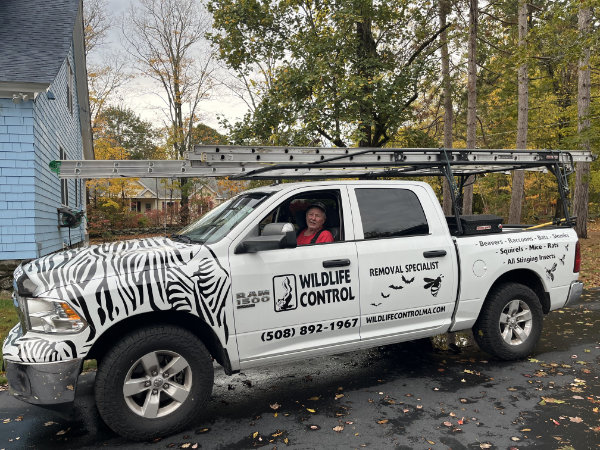
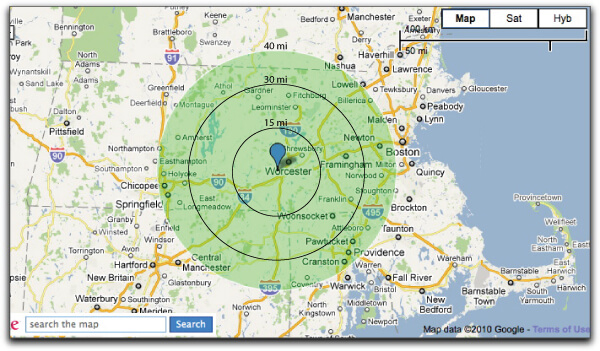
Wildlife Control is ideally located in the center of the state, and can service most of the cities and towns of Massachusetts. Our standard service area covers all the towns of Central and MetroWest Massachusetts, west of Boston and east of Springfield
If you have a special situation that requires our expertise, and are outside of the standard service area, then please call to discuss.
For Beavers, we service the entire state of Massachusetts.
All jobs are quoted individually because of unique circumstances of situation and distance from home base
Residential Removal:
There is a non-refundable fee to cover the Initial cost of setting up the traps, trap monitoring, baiting and taking down the traps, for most types of wildlife.
Charges per activity / animal removal: It is not uncommon to set many traps, and remove many animals, over a span of weeks. State law requires that captured animals removed from the property be euthanized.
Squirrels: Because of the large number of animals frequently captured in a squirrel situation, a flat rate fee is often used instead. Price to be determined after reviewing the location. Call for quote.
Beaver and Bat removals* are always special circumstances. Please call to discuss rates.
*Bat treatments are warranteed for 2 years;
Price for exclusion work varies.
Animals are very resourceful in regard to finding or creating an entry into a building.
The best solution for wildlife control is to keep them out.
Commercial: Call for Quote.
Setting traps, checking traps, and following up on trapped animals requires a lot of travel time, trial and error, sleuth work, dedication and return trips. Few jobs are easy, but some are less difficult than others.
The most common reason for contract modification is non-target catches and poor owner cooperation. If the contract is to be modified, then we will give the owner at least one day advance notice. We reserve the right to stop trapping, continuing, and/or to return at a later date.
We cannot guarantee that after removal of an animal(s), that another animal will not re-inhabit the same place by following scent markings (except bats and mice). The price for exclusion work may or may not be added to the contract, as circumstances require.
The owner is responsible for the security of all traps. The number of traps used will vary on a daily basis. In high risk environments, a security deposit per trap will be required. When traps are set inside the building, the owner is responsible for providing access to the property.
Wildlife Control is not responsible for any damage which may be incurred to the buildings, belongings or yard areas while working to secure or remove animals
Wildlife Control is not a franchise. We are a family of busy trappers.
Please Call
508-892-1967
for Service.
If you call and get our voice mail, then please leave a message and we will get back to you as soon as we are able.
Mail Address:
Wildlife Control
PO Box 122
Rochdale, MA 01542
Wildlife Control is owned and operated by
Wayne Witkowski Sr.
and
Wayne Witkowski Jr.
Thank you for checking out our website.
www.wildlifecontrolma.com
Home Range: 1 to 5 miles
Food: Small mammals, carrion, insects, fruit.
Mating: December to March
Gestation: 52 days
Young born: March to May
Number of young: 1 to 2
Number of litters: 1
Young independent: 1 Month
Home Range: Usually within 200 to 300 yards of the lodge.
Food: Leaves from plants and bark from trees.
Mating: January to March in North, November to January in South.
Gestation: 100 to 110 days
Young born: April to July in North; February to April in South
Number of young: 1 to 4
Number of litters: 1
Young independent: Males leave lodge at 1 to 2 years.
For Beavers, we service the entire state of Massachusetts.
There are a large number of bird species in Massachusetts:
Each species has its peculiarities. Some are protected, like woodpeckers. They cannot be trapped and removed, but steps can be taken to discouraging them from visiting and damaging your property.
Home Range: 1/2 to 3 acres.
Food: Seeds, nuts and fruits.
Mating: February to April; June to July
Gestation: 31 Days
Young born: April to May; July to August
Number of young: 3 to 7
Number of litters: 1 to 2
Young independent: Weaned at 4 weeks, independent at 8 weeks.
Home Range: 5 to 25 square miles.
Food: Mice, voles, rabbits and other small animals, fruits, berries, deer, domestic livestock, carrion, garbage.
Mating: January to April
Gestation: 58 to 63 days
Young born: March to May
Number of young: 5 to 7
Number of litters: 1
Young independent: Disperse at 6 to 9 months, but sometimes stay with parents and form a pack.
Home Range: 1 to 3 acres.
Food: Nuts, buds, seeds, flowers, cones, fruits.
Mating: December to February; June to July
Gestation: 45 days
Young born: February to April; September to October
Number of young: 3 to 5
Number of litters: 2
Young independent: Weaned at 8 to 9 weeks. independent at 3 to 4 months.
Home Range: 1/10 to 2 1/2 acres.
Food: Fruits, seeds, insects, nuts, cones.
Mating: February to October
Gestation: 23 days
Young born: March to November
Number of young: 1 to 5
Number of litters: 2 to 4
Young independent: 3 1/2 to 4 weeks.
Important information about mice treatement:
When mice are detected in your home or building by one of our technicians, they will go over the treatment options available to you so that you are more educated in your decision.
Once you have decided how you would like your issue handled our technician will place the correct rodenticide into "childproof"/"pet proof" boxes in designated areas of your home or building. These areas MAY include: basements, under sinks, garage areas, outside the building, attics, or any other place not listed that the technician feels will help with your rodent issues.
The rodenticide being left in your home is tailored for rodents, and locked into special boxes so that animals and children cannot get to it. The rodenticide is also made to protect against secondary poisoning (when a dog or cat eats a mouse that has ingested the rodenticide they will not be harmed.)
Homeowners/business owners must be aware of the following after rodenticide has been put down:
The effectiveness of the rodenticide is roughly 6-8 months depending on numerous variables (such as weather, dampness, etc.)
The rodenticide needs 10-14 days to be found by rodents. They smell it as food, but it can take time for them to find it and eat it.
Any rodent ingesting the rodenticide will have organ failure and die within 72 hours of ingestion. Wildlife Control is not responsible for where the animal dies (although in that time period mice can travel a reasonable distance)
The rodenticide is not a cure all for rodents in your home/business. They can still enter your building and even with poison you may see them inside again. The poison prevents the rodents from establishing a "home" site which leads to major infestations. Rodents can reproduce every 21 days, thus having properly installed rodenticide disrupts their attempts to establish a "home" area. Attempting to "rodent proof" your home is available at additional cost, but is quite expensive due to the fact that mice can fit in the tiniest of spaces. This service still does not guarantee total protection from mice as they can fit into holes the size of a pencil.
Home Range: 1/2 to 2 acres.
Food: Small animals, insects, earthworms, mice.
Mating: February to April
Gestation: 4 to 6 weeks
Young born: March to June
Number of young: 3 to 7
Number of litters: 1
Young independent: 4 to 7 weeks.
Lots of different things can form a nest. There are a lot of different styles of nests. Please contact us for help.
Home Range: A few acres in winter to 200 acres in summer.
Food: Plants and bark from trees.
Mating: September to December
Gestation: 205 to 215 days
Young born: April to August
Number of young: 1
Number of litters: 1
Young independent: Weaned at 3 1/2 months.
Info to follow
Home Range: 10 acres to several square miles.
Food: Crayfish, insects, frogs, berries, fruits, vegetables, garbage.
Mating: December to February
Gestation: 9 weeks
Young born: February to April
Number of young: 3 to 7
Number of litters: 1
Young independent: Weaned at 10 to 16 weeks, independent 4 to 6 months.
Info to follow
Home Range: 1 to five square miles.
Food: Small mammals, carrion, insects, fruit.
Mating: December to March
Gestation: 52 days
Young born: March to May
Number of young: 1 to 5
Number of litters: 1
Young independent: Disperse at 6 to 9 months.
Home Range: 2 to 5 acres.
Food: Nuts, seeds, berries, buds, mushrooms.
Mating: February to March, June to July
Gestation: 5 weeks
Young born: Late March to May, late July to September
Number of young: 2 to 8
Number of litters: 1 to 2
Young independent: 7 to 8 weeks.
Home Range: 1/2 square mile.
Food: Voles, mice, beetle grubs, insects, eggs of birds and turtles, berries, garbage.
Mating: February to March
Gestation: 62 to 66 days
Young born: April to June
Number of young: 2 to 10, average 5 to 7
Number of litters: 1
Young independent: Weaned at 2 months, independent by fall.
There are a large number of different snakes in Massachusetts:
Black Racer • Black Rat • Brown • Copperhead • Common Garter • Eastern Hognose • Eastern Ribbon • Milk • Northern Water • Redbelly • Ringneck • Smooth Green • Timber Rattlesnake • Worm Snake
There are a large number of flying insects in Massachusetts:
We are fully licensed and experienced pest control technicians.
Home Range: 75 to 200 square yards.
Food: Grasses and seeds.
Mating: All year in South; may stop during winter in North.
Gestation: 20 to 23 days
Young born: All year in South; may stop during winter in North.
Number of young: 4 to 5
Number of litters: 2 to 3
Young independent: 2 to 3 weeks.
Home Range: 1/2 to 3/4 acre.
Food: Grasses and plants.
Mating: February to April
Gestation: 4 weeks
Young born: March to May
Number of young: 2 to 9, average 4 to 6
Number of litters: 1
Young independent: 10 to 12 weeks.
Animals are our passion and our business. We treat them as humanely as possible.